The lush bushveld of the Lowveld in Mpumalanga combined with its warm, humid climate make this region the ideal habitat for snakes. Finding these slithery creatures in home gardens in the area is standard and although this may make us feel that we truly are close to the wonders of nature, it unfortunately also poses a threat to our domestic animals, especially dogs.
The danger to our pets
when it comes to snakes isn’t only related to snake bites. Throughout the year
local veterinarians are inundated with emergency calls and visits from pet
owners whose furry family members have been spat in the eye by the Mozambique
Spitting Cobra.
These species of snakes
can eject their venom up to about two meters
and remarkably enough know exactly how to aim for the eyes. In fact, there is
evidence that if a spitting snake spits at you while you are moving from side
to side, it will predictively spit ahead of you so that the venom gets into
your eyes at the right time. Although this is an amazing fact of nature, it
isn’t so great if you are a nosy and determined dog that’s determined to take
on these fearless reptiles.
We use a special dye (fluorescein) to determine the extent of the damage caused by the venom to the eye’s cornea. The green in the photo shows the damaged part of the eye.
Venom in the eyes is extremely painful.
In fact, some have related the feeling to that of rubbing the eyes with a
mixture of sand and petrol. So, when your dog suffers this fate it’s essential
that you treat it immediately, and correctly.
As soon as it happens, or you realise it has happened, it is vital that
you follow the three-step plan:
Step 1 – Flush the animal’s
eye with clean water. Rinse the eye completely and repeat 5 minutes later. This
needs to be done even if there is no evidence of damage to the eye (watery or
closed eye).
Step 2 – Take the animal to
the vet as soon as possible. If it is during office hours, it is advisable to
take the animal to your local vet immediately. If the incident happens after
hours follow Step 1 and call your vet for advice.
Step 3 – On examination, the
vet will examine the eye. They use a special dye call fluorescein to stain the
cornea. This stain helps to determine the damage to the cornea that might be
invisible to the naked eye. Specific treatment will be implemented based on the
severity and extent of corneal damage. Please be aware, pets lose their
eyesight if not treated with the right medication. One of the many reasons why
a vet can’t dispense medication over the counter for these injuries.
Do you live in a highly-populated snake area? Or would you like to be prepared in case your pet does suffer the fate of getting spat in the eye? We have a special Kryon Eye Wash bottle that can be bought at our clinic or online – this makes flushing the eye a lot easier and doesn’t burn the eye at all!
It is of vital importance to ensure your cat & dog vaccinations are up to date. Vaccinations protect against viral and bacterial diseases.
Any pet, whether indoors or outdoors, are at risk of getting infected. It is much more costly to treat your pet for a serious illness, that could have been prevented if your pet was vaccinated. See the vaccination guideline for South Africe below.
Basic vaccination programme for dogs
Antigen
Initial puppy vaccination
Initial adult vaccination
Re-vaccination recommendation
CPV, CDV, and CAV-2
Core
6 weeks
9 weeks
12 weeks
Thereafter veterinarians may suggest to vaccinate again at 16 weeks and perform serological testing to confirm protective titres thereafter
Two doses 3 weeks apart
Booster at 6 months of age to 1 year of age and thereafter every third year (use of vaccines with a licensed DOI of three years is encouraged)
Rabies
Core
12 weeks
4 months of age to 12 months of age
Single dose
Every 3 years (use of vaccines that have a three-year duration of immunity claim on the manufacturer’s data sheet is encouraged). When pet is likely to travel, recommendation should be annually.
Parainfluenza
Non-core but highly recommended
6 weeks
9 weeks
12 weeks
Thereafter veterinarians may suggest to vaccinate again at 16 weeks and perform serological testing to confirm protective titres thereafter
Two doses 3 weeks apart
Revaccination (booster) at
either 6 months or 1 year of
age, then annually for all pets at risk
Bordetella bronchiseptica
Non-core but highly recommended
As per data sheet from manufacturer
Two doses 3 weeks apart if booster is required or single intranasal dose
Annually for all pets at risk
Leptospirosis
Non core
Initial dose at 8 weeks of
age or older. A second
dose is given 3 weeks
later
Two doses 3 weeks apart
Annually for all pets at risk. Local relevance remains questionable and further research is required. Travel regulations may require vaccination against Leptospirosis.
Canine corona virus
Not recommended
Basic vaccination programme for cats
Antigen
Initial kitten vaccination
Initial adult vaccination
Revaccination recommendation
FPV, FHV-1, FCV
Core
6 weeks
9 weeks
12 weeks
Thereafter veterinarians may suggest to vaccinate again at 16 weeks and perform serological testing to confirm protective titres thereafter
Two doses 3 weeks apart
Booster at 6 months of age to 1 year of age and thereafter every year in cats with high risk and every third year in cats with low risk with owner informed consent
Rabies
Core
12 weeks and again at 4 months of age to 12 months of age
Single dose
Every 1-3 years depending on whether the cat is likely to travel or not
Feline Leukaemia Virus
Non-core but highly recommended in young cats
8-9 weeks of age with a second dose
administered 3 weeks later
Two doses 3 weeks apart
Revaccination (booster) at 6 months to 1 year of age, then annually for cats with sustained risk
Bordetella bronchiseptica
Non-core
Administer a single dose intranasal as early as 4 weeks of age.
Administer a single dose intranasal.
Annual booster is indicated for cats with sustained risk
Chlamydia felis
Non-core
Initial dose at 8 weeks of age or older. A second dose is given 3 weeks later
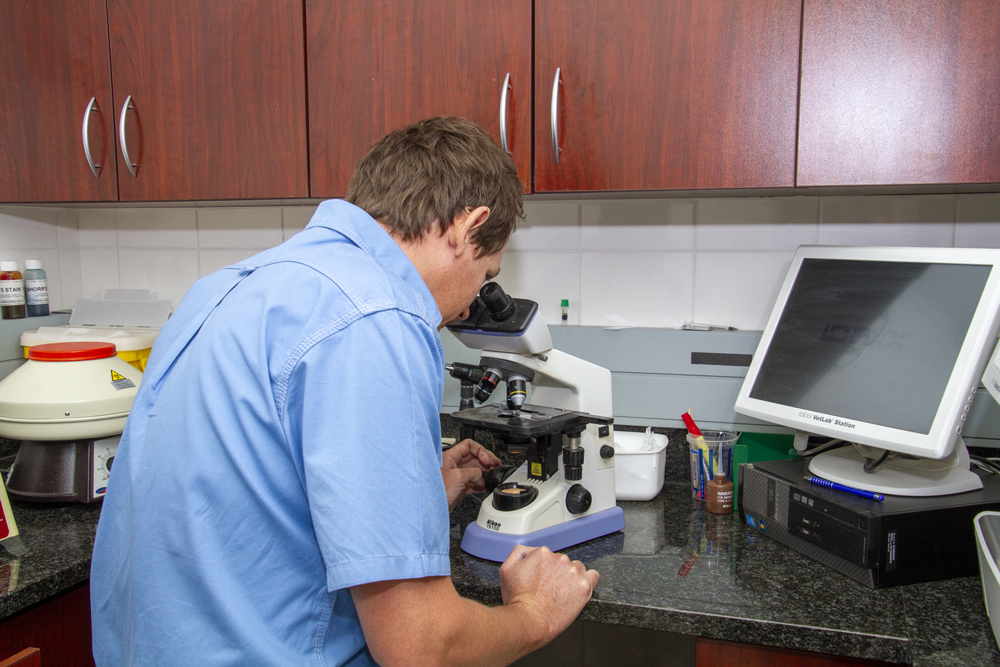
We have the equipment and capability to do diagnostic health work-ups and pre-anaesthetic bloods, when a physical examination of the animal is insufficient to get to a diagnosis.
We are aware of the costs of diagnostic tests, and we only run the tests that we deem are absolutely necessary.
African horse sickness is a highly infectious and deadly disease caused by the African horse sickness virus. It commonly affects horses (mortality rate 70-90%), mules, and donkeys. Zebras and donkeys rarely develop serious symptoms.
How do horses contract the disease?
AHS does not spread directly from one horse to another but is transmitted by the Culicoides midge ( also called “punkies” or “no-see-ums” ), which becomes infected when feeding on other infected Equidae. Mosquitoes and biting flies may also be able to transfer the virus.
Blood-feeding Culicoides Midges
It occurs mostly in the warm, rainy season when midges are plentiful, and disappears after frost when the midges die. Most animals become infected in the period associated with sunset and sunrise when the midges are most active.
Symptoms:
The disease manifests in three ways, namely the lung form, the heart form and the mixed form. The lung (dunkop) form is characterised in the following manner:
very high fever (up to 41 degrees).
difficulty in breathing, with mouth open and head hanging down.
frothy discharge may pour from the nose.
sudden onset of death.
very high death rate (90%).
This form of the disease has the highest mortality rate. (90%)
The heart (dikkop) form is characterised in the following manner:
fever, followed by swelling of the head and eyes.
in severe cases, the entire head swells (“dikkop”).
loss of ability to swallow and possible colic symptoms may occur.
terminal signs include bleeding (of pinpoint size) in the membranes of the mouth and eyes.
Slower onset of death, occurring 4 to 8 days after the fever has started.
Mortality rate is between 50 and 70%, and survivors recover in 7 days
The mixed form is characterised by symptoms of both the dunkop and dikkop forms of the disease.
Diagnosis and Notification
The symptoms described above may assist with an initial diagnosis of AHS. This diagnosis can only be confirmed by identifying the virus in a laboratory. It is, therefore, essential that blood samples be taken from the horse during the fever stage of the disease for analysis. As AHS is a controlled disease, horse owners are obliged by law to notify the local State Veterinarian of suspected cases.
There is no specific treatment for animals with AHS apart from rest and good husbandry. Complicating and secondary infections should be treated appropriately during recovery.
Control of African Horse Sickness
African Horse Sickness (AHS) is one of a number of diseases known to be potentially damaging to the livestock economy. By way of the Animal Diseases Act (Act No. 35 of 1984), AHS has been declared a state-controlled disease, thereby empowering the state to implement measures to control the disease. Horse owners are also required by this law to notify their local state veterinarian of any cases of AHS. The Act also requires that all equines (horses, donkeys and mules) must be vaccinated at least once a year with an approved AHS vaccine.
How can I protect my animals from African horse sickness?
The best way to protect animals from African horse sickness is to make sure they get their annual vaccinations, as well as to decrease their exposure to biting midges and other insects (e.g., mosquitoes and biting flies). Stabling horses in insect-proof housing, particularly between dusk and dawn when the insects are most active, can help prevent exposure. Insect repellents and insecticides may also be useful. Monitor your horse’s temperature. Horses with fevers should be examined by your veterinarian.
African Horse Sickness Vaccination Programme
All horses and all foals should be vaccinated against African Horse Sickness by a veterinary surgeon, using a registered, non-expired vaccine supplied by the Veterinarian administering the vaccine.
Foals between the ages of 6 and 18 months should get two sets of vaccines not less than 30 days apart, where possible, between 1 June and 31 October; and thereafter every year between 1 June and 31 October.
Contact us if you have any questions and any of our friendly vets will assist.
A variety of agricultural insecticide products are utilised daily to control insects in crops as well as in our homes and gardens. Various products are also registered for the control of external parasites on dogs, cats, horses and livestock. A range of chemical active ingredients, including organophosphates and carbamates, are included in products for agricultural and household as well as in flea collars and other topical tick and flea control products.
Misuse and overexposure
result in animals and humans being poisoned. Many pet animals are targeted
annually and die as a result of toxin misuse for criminal intent such as house
breaking and theft.
Carbamates and organophosphates are related toxins that affect the nervous systems of animals and humans, interfering with conduction of impulses to the heart, muscle and intestinal tract.
Read more here on what these toxins look like, precautions, signs of poisoning, how should a poisoned animal be handled, what treatment is required, how should contaminated material be disposed of and how poisoning can be prevented.